
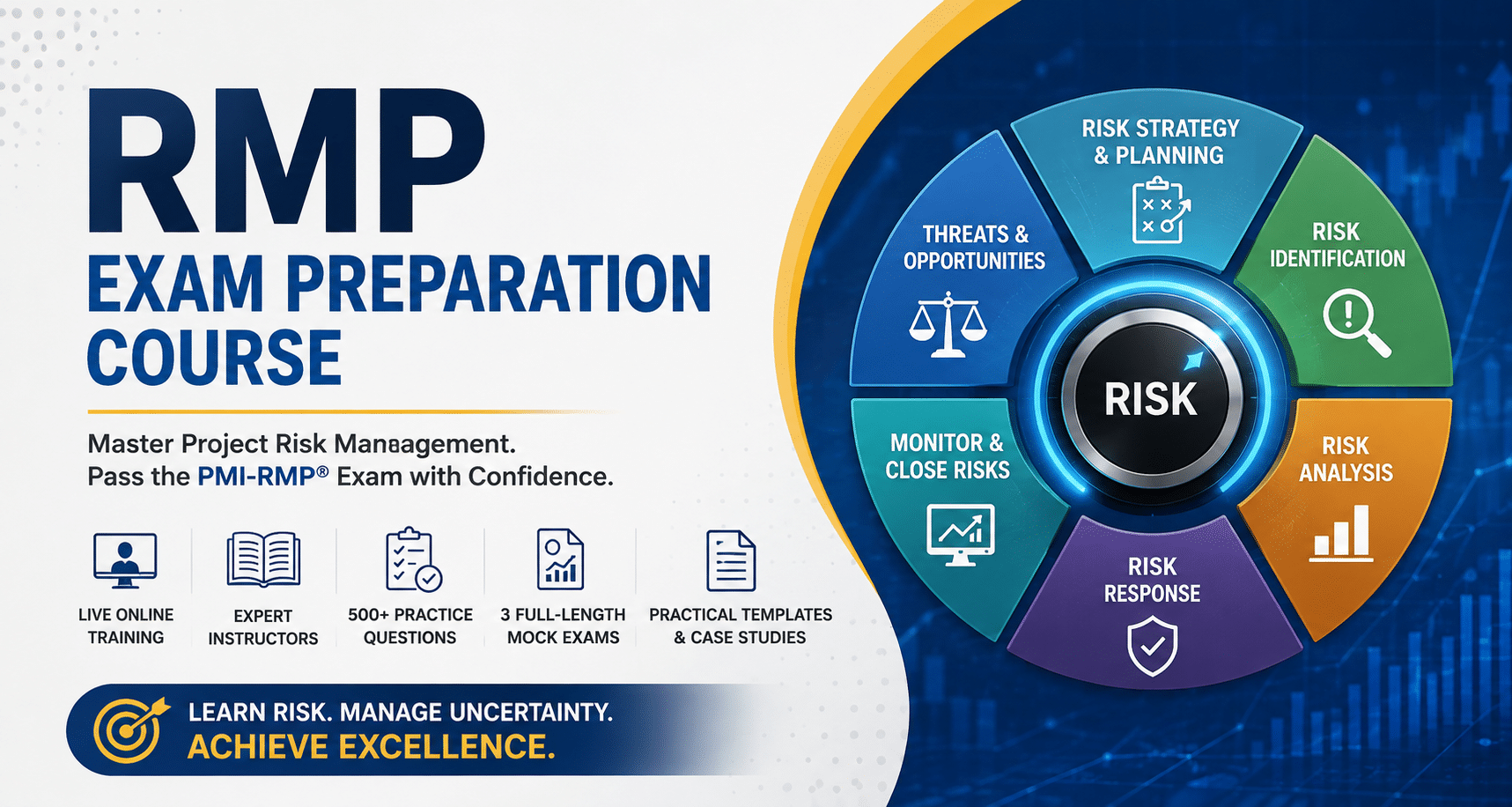
PMI-RMP® Online Exam Preparation Course
Become a Certified Project Risk Management Professional
Prepare for the PMI Risk Management Professional (PMI-RMP)® certification with a structured, practical, and exam-focused online training program.
This course is designed to help you understand project risk management concepts, apply them in real-world projects, and confidently prepare for the PMI-RMP® certification exam.
Course at a Glance
Course Name: PMI-RMP® Risk Management Professional Exam Preparation
Delivery Mode: Live Online Instructor-Led Training
Recommended Schedule: 15 Classes × 2 Hours
Optional Extended Program: 40 Hours
Mock Exams: 3 Full-Length Mock Exams
Class Materials: Digital Notes, Templates, Exercises & Practice Tests
Suitable For: Beginners to Experienced Project Professionals
Why Take the PMI-RMP® Certification?
Project risks can directly affect cost, schedule, quality, resources, stakeholder satisfaction, and overall project success.
The PMI-RMP® certification demonstrates your specialized knowledge and skills in identifying, analyzing, responding to, and monitoring project risks.
This course helps you develop practical skills in:
Risk planning
Risk identification
Qualitative risk analysis
Quantitative risk analysis
Risk response planning
Risk monitoring and reporting
Risk communication
Threat and opportunity management
Agile and hybrid risk management
PMI-RMP® exam preparation
Who Should Join This Course?
This course is suitable for professionals working in project, program, operations, risk, engineering, technology, finance, and management roles.
Ideal participants include:
Project Managers
Risk Managers
Program Managers
PMO Professionals
Project Coordinators
Planning Engineers
Cost Engineers
Project Control Professionals
Business Analysts
IT Professionals
Engineers
Construction Professionals
Banking Professionals
Financial Services Professionals
Compliance Professionals
Quality Professionals
Consultants
PMP® certified professionals
Professionals planning to earn PMI-RMP®
PMI-RMP® Exam Domains Covered
The training follows the key PMI-RMP® examination domains.
| Exam Domain | Weight |
|---|---|
| Risk Strategy and Planning | 22% |
| Risk Identification | 23% |
| Risk Analysis | 23% |
| Risk Response | 13% |
| Monitor and Close Risks | 19% |
| Total | 100% |
What You Will Learn
By completing the course, you will learn how to:
Develop an effective project risk management strategy.
Understand organizational risk appetite, tolerance, and thresholds.
Create a professional Risk Management Plan.
Develop a Risk Breakdown Structure.
Identify threats and opportunities.
Conduct risk identification workshops.
Create and maintain a Risk Register.
Perform qualitative risk analysis.
Build and interpret Probability and Impact Matrices.
Prioritize project risks.
Perform quantitative risk analysis.
Calculate Expected Monetary Value.
Apply decision-tree analysis.
Understand Monte Carlo simulation.
Analyze cost and schedule uncertainty.
Select appropriate responses for threats.
Select appropriate responses for opportunities.
Develop contingency and fallback plans.
Monitor risk triggers and emerging risks.
Conduct risk reviews and risk audits.
Communicate risk information to stakeholders.
Apply risk management in predictive, agile, and hybrid projects.
Answer PMI-RMP® scenario-based exam questions.
Course Curriculum
Module 1 – PMI-RMP® Introduction & Risk Management Fundamentals
Learn the foundation of project risk management and understand how the PMI-RMP® exam is structured.
Topics Include
PMI-RMP® certification overview
PMI-RMP® exam domains
Project risk management fundamentals
Individual project risk
Overall project risk
Threats and opportunities
Risk vs. issue
Assumptions and constraints
Known and unknown risks
Risk causes and effects
Risk management lifecycle
Predictive, agile, and hybrid environments
Module 2 – Risk Strategy and Planning
Learn how organizations establish a structured approach to managing project uncertainty.
Topics Include
Organizational risk environment
Project documents
Historical information
Enterprise Environmental Factors
Organizational Process Assets
Risk culture
Risk maturity
Stakeholder attitudes toward risk
Risk appetite
Risk tolerance
Risk thresholds
Internal and external risks
SWOT analysis
PESTLE analysis
Module 3 – Risk Management Plan
Learn how to prepare a comprehensive project Risk Management Plan.
Topics Include
Risk methodology
Roles and responsibilities
Risk governance
Risk categories
Risk Breakdown Structure
Risk ownership
Probability scales
Impact scales
Probability and Impact Matrix
Risk scoring
Risk reporting
Risk escalation
Risk review frequency
Risk management budget
Risk communication planning
Module 4 – Risk Identification
Develop the ability to identify project threats and opportunities systematically.
Techniques Covered
Brainstorming
Interviews
Expert judgment
Delphi technique
Checklists
Prompt lists
Document analysis
Root cause analysis
Assumption analysis
Constraint analysis
SWOT analysis
Fishbone diagram
Cause-and-effect analysis
Facilitation
Risk workshops
You will also learn how to write clear risk statements using:
Cause → Risk Event → Effect
Module 5 – Risk Register Development
Learn how to develop and maintain a professional Risk Register.
A typical Risk Register may include:
Risk ID
Risk category
Risk description
Root cause
Probability
Impact
Risk score
Priority
Risk owner
Response strategy
Trigger
Action owner
Status
Participants will complete a practical Risk Register exercise during the course.
Module 6 – Qualitative Risk Analysis
Learn how to prioritize risks based on their probability, impact, urgency, and other characteristics.
Topics Include
Probability assessment
Impact assessment
Probability and Impact Matrix
Risk scoring
Risk ranking
Urgency
Proximity
Dormancy
Detectability
Manageability
Controllability
Data quality
Risk categorization
Stakeholder bias
Risk prioritization
Module 7 – Quantitative Risk Analysis
Learn how numerical techniques can be used to determine project uncertainty and exposure.
Topics Include
Quantitative risk analysis fundamentals
Probability distributions
Three-point estimates
Optimistic estimates
Most likely estimates
Pessimistic estimates
Expected Monetary Value
Decision-tree analysis
Contingency reserves
Cost uncertainty
Schedule uncertainty
Module 8 – Advanced Quantitative Analysis
Understand advanced methods frequently tested in PMI-RMP® scenarios.
Topics Include
Monte Carlo simulation
S-curves
Confidence levels
Sensitivity analysis
Tornado diagrams
Criticality analysis
Cost risk analysis
Schedule risk analysis
Risk-adjusted forecasts
Correlation between risks
No advanced software experience is required to understand these concepts.
Module 9 – Risk Response Planning
Learn how to choose effective responses for both threats and opportunities.
Threat Response Strategies
Avoid
Mitigate
Transfer
Accept
Escalate
Opportunity Response Strategies
Exploit
Enhance
Share
Accept
Escalate
Additional Topics
Contingency plans
Fallback plans
Workarounds
Residual risks
Secondary risks
Risk triggers
Risk ownership
Response ownership
Contingency reserves
Evaluating response effectiveness
Module 10 – Monitor and Close Risks
Learn how to manage risks throughout the full project lifecycle.
Topics Include
Implementing risk responses
Tracking identified risks
Monitoring triggers
Emerging risks
Risk reassessment
Risk review meetings
Risk audits
Reserve analysis
Variance analysis
Trend analysis
Risk reporting
Risk escalation
Risk closure
Lessons learned
Continuous improvement
Module 11 – Risk Communication & Stakeholder Management
Learn how risk professionals communicate uncertainty effectively to decision-makers and project stakeholders.
Topics Include
Risk communication planning
Stakeholder engagement
Risk reports
Risk dashboards
Heat maps
Executive reporting
Risk escalation
Difficult risk conversations
Negotiation
Influencing stakeholders
Building a positive risk culture
Module 12 – Agile & Hybrid Risk Management
Learn how project risks are handled in modern delivery environments.
Topics Include
Risk in agile projects
Risk in predictive projects
Hybrid risk management
Iterative risk identification
Sprint risks
Release risks
Product risks
Technical debt
Backlog prioritization
Agile retrospectives
Continuous risk assessment
Adaptive risk response planning
PMI-RMP® Exam Preparation
The final part of the course is focused specifically on examination techniques.
You will learn how to approach questions such as:
What should the Risk Manager do FIRST?
What should the Risk Manager do NEXT?
What is the BEST response?
Which action should be taken MOST appropriately?
What should the project team have done?
What should the Risk Manager review before taking action?
We also cover:
Scenario-based questions
Situational questions
Calculation questions
Agile and hybrid scenarios
Threat response questions
Opportunity response questions
Qualitative analysis questions
Quantitative analysis questions
Time-management techniques
Answer elimination strategies
Common PMI exam traps
Practice Questions & Mock Exams
Practice is an important part of PMI-RMP® preparation.
Participants will receive access to:
500+ Practice Questions
Including:
Chapter-based quizzes
Domain-based questions
Scenario-based questions
Calculation questions
Agile and hybrid questions
Full Mock Exams
Mock Exam 1 – 115 Questions
Mock Exam 2 – 115 Questions
Final Exam Simulation – 115 Questions
Detailed answer explanations will be discussed during the course.
Practical Exercises
This course is not limited to theory.
Participants will work on practical exercises including:
Risk identification workshop
SWOT risk analysis
PESTLE analysis
Risk Breakdown Structure
Risk Register preparation
Probability and Impact Matrix
Risk prioritization
EMV calculations
Decision-tree calculations
Risk response planning
Risk review meeting
Risk reporting
Case-study analysis
Templates Included
Participants will receive editable templates for:
Risk Management Plan
Risk Register
Risk Breakdown Structure
Probability and Impact Matrix
Risk Assessment Worksheet
Risk Response Plan
Risk Report
Risk Heat Map
Risk Review Template
Risk Audit Checklist
Lessons Learned Register
Assumption Log
Issue Log
Contingency Reserve Worksheet
Stakeholder Risk Assessment
Important Risk Formulas Covered
Expected Monetary Value
EMV = Probability × Impact
Risk Exposure
Risk Exposure = Probability × Impact
PERT Expected Value
Expected Value = (Optimistic + 4 × Most Likely + Pessimistic) ÷ 6
Standard Deviation
Standard Deviation = (Pessimistic − Optimistic) ÷ 6
Variance
Variance = Standard Deviation²
The course also explains how these calculations are used in practical PMI-RMP® examination scenarios.
40 Hour Program
Candidates who need additional risk management education hours may choose the extended program.
The additional 10 hours may include:
Advanced Monte Carlo concepts
Advanced quantitative analysis
Risk workshop facilitation
Enterprise and program risk concepts
Real-world project case studies
Advanced examination questions
Additional mock exam review
Total Extended Training: 40 Hours
Course Materials Included
Participants receive:
PMI-RMP® focused digital course notes
Presentation slides
Formula sheet
Exam terminology guide
Practical templates
Case studies
Exercises
Chapter quizzes
Practice questions
Mock exams
Exam preparation checklist
Recommended study plan
Recommended Study Approach
For best results, candidates should:
Attend all live classes.
Review each module after class.
Complete chapter quizzes.
Practice scenario-based questions regularly.
Review incorrect answers carefully.
Learn risk terminology and response strategies.
Practice numerical questions.
Complete all full-length mock exams.
Review weak domains before the final examination.
Enroll in the Next Online Batch
Live Online Classes | Expert Guidance | Practical Templates | 500+ Practice Questions | Full Mock Exams
Register Now
Start Date:
01 May, 2026
Total Class:
45 Hours
Class:
Friday & Saturday
Class Time:
8:00 PM - 11:00 PM
Class Method
Online Live

Nujhat Nahar
PMP®|CSPO®| PRNCE2®| ITIL®| ISO9001®I SO20K®| CMMI®|15 years + in Project Management |Agile Scrum| Team Management & Leadership| Odoo ERP